
- Time
- About 15 minutes per faucet
- Budget
- About $5 to $10 per foam cover
- Skill
- Beginner
- Tools
- Bucket, flashlight
You will remove the hose, shut off the water inside, drain the outdoor faucet, and fit it with a foam cover. Each faucet takes about 15 minutes, and most homes need no special tools. Once it's done, you can stop worrying about that spigot until spring.
Why draining matters
Water expands when it freezes. Inside a pipe or faucet, that expansion builds up a lot of pressure, which can damage pipes and spigot parts. If you drain the water out first, nothing is left to freeze.
When to do it
Pick a mild fall afternoon before your first hard freeze. In many areas that falls in October or November. If the forecast is heading into the 20s, do it now. University of Illinois research found that pipes in unheated spots can start to freeze below about 20 degrees outside. Pipes can still freeze above that, so it's better to be early than late.
What you will need
- A bucket, to catch water from the faucet
- A flashlight, for finding the shutoff valve in a basement or crawl space
- A rag or towel, for drips at the valve
- An insulated foam faucet cover, one per outdoor faucet
- Foam pipe insulation (optional), for any pipe that runs through an unheated garage or crawl space
For the cover, choose one with a cord loop that pulls tight. That lets it sit flat against the wall so wind can't get under it. A two-pack covers most homes.
Count your faucets first
Walk around the outside of the house before you start. Many homes have more than one outdoor faucet, and the one behind the shrubs is easy to forget.
Step by step
-
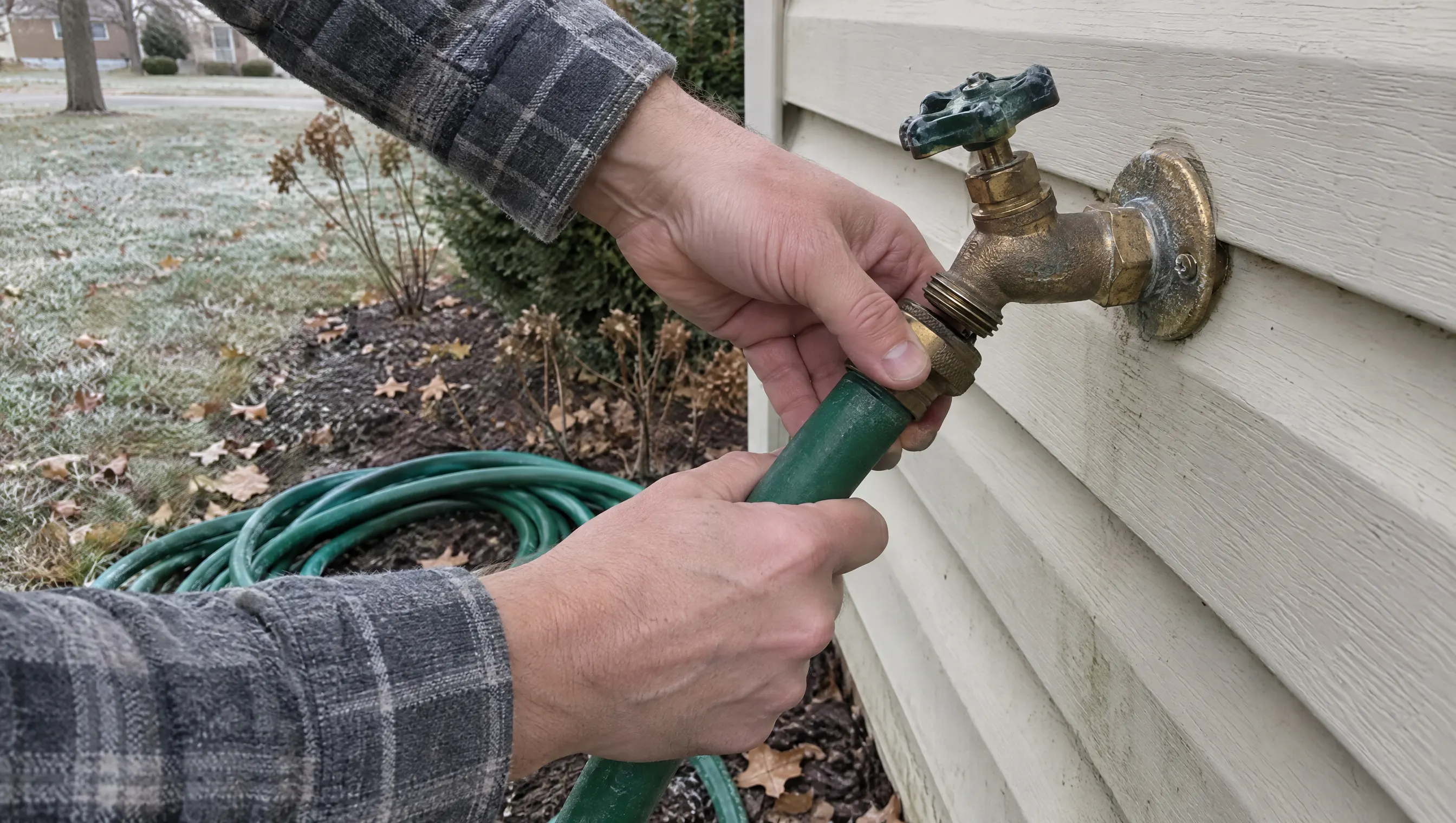
Take off the hose. Unscrew the garden hose and any splitter or timer. Drain the hose, coil it, and store it in the garage or shed. Do this even if you have a frost-free faucet. Those are built to drain after each use, but only when no hose is attached. With a hose on, water stays in the faucet and freezes there.
-
Close the inside shutoff valve. Find the spot on the inside of the wall behind the outdoor faucet. It is usually in the basement, a crawl space, or a utility room. Look for a small valve on the pipe that runs to that wall. A round handle turns clockwise until it stops. A lever handle turns so it sits across the pipe. Put a rag under the valve to catch drips.
-
Drain the outdoor faucet. Go back outside and set the bucket under the spout. Open the faucet all the way. You'll get a short rush of water, then a trickle, then nothing. That was the water sitting in the pipe. If the flow keeps going and doesn't slow down, the inside valve isn't fully closed, so go back and give it another turn.
-
Fit the foam cover. Slip the cover's loop over the faucet and pull the cord tight so the cover sits flat against the wall. The cover works like a small jacket and helps on bitter nights, but only on a faucet you have already drained.
Two mistakes to avoid
Leaving the hose on. Even a frost-free faucet traps water when a hose is attached. Take the hose off every fall.
Covering a full faucet. A cover holds in a little warmth, but it can't stop a full pipe from freezing during a long cold snap. Drain first, then cover.
What it costs
- $0 for the most important part: hose off, valve closed, faucet drained.
- About $5 to $10 per faucet if you add a foam cover. This is a planning estimate, and covers are sold singly and in packs.
- $150 to $400 to have a plumber add an inside shutoff valve or install a frost-free faucet. This is also a planning estimate. Prices vary a lot by area, so get a quote.
If there's no inside shutoff valve
Some older homes don't have one. If you can't find a valve on the pipe behind the faucet, take the hose off and put a cover on for now. Then have a plumber install a shutoff. It's a small job for them, and after that this becomes a 15-minute task every fall.
If a pipe freezes or bursts
Never thaw a frozen pipe with an open flame or a torch. You may be able to thaw it with a hand-held hair dryer, starting near the faucet end with the faucet open. If a pipe bursts, shut off the water at your main shutoff valve and call a plumber. Make sure everyone in the house knows where the main valve is before winter, not during a leak.
Checking your work and turning it back on
On the first freezing morning, look at the faucet. If the spigot isn't frosted solid and nothing is leaking at the wall, it's ready for winter.
Keep the inside valve closed until the last hard freeze has passed in spring. To turn the water back on, make sure the outdoor faucet is closed, open the inside valve, and check for drips.

0 comments
Join the conversation