
- Skill
- Beginner
- Focus
- Brush load, brush size, moisture control
- Tools
- Large round and small round brushes
When a line comes out too thick, paint creeps where you didn't want it, or your brush runs dry halfway across a shape, the cause is rarely your hand. It is usually how much water and paint is sitting in the brush, and which size of brush you picked up. In about an hour you can learn to read a brush before it touches the paper, change its load on purpose, and practice until the habit sticks.
Why the load matters more than a steady hand
A brush stores water between its hairs. That capacity is called the reservoir, and its size changes two things: how fast paint flows onto the paper, and the shape of the brush head while you work.
Natural hair, such as sable, holds more water than synthetic, even synthetics made specially for watercolor. Everything below works with both. With synthetics you will just reload more often.
What you will need
- A large round brush, for bigger shapes
- A small round brush, for details and fine lines
- Watercolor paints and a palette
- An absorbent cloth or paper towel
- A sheet of watercolor paper
- A scrap of paper to keep beside your painting
Step by step
- Load the brush fully. Dip it in paint until it is heavy. Look at it: the belly bulges and the tip turns rounded, because water is holding the hairs apart.
- Touch it to the paper. A lot of paint comes off quickly, in a blob. This fast, loose release is what you want for large shapes, since you can cover a big area without stopping to reload. It is not what you want for precise work.
- Blot the same brush on the cloth. With less moisture, the hairs come back together into a pointed tip. Paint now releases slowly enough for a tiny dot or a thin line that doesn't spread. Same brush, very different mark. Only the load changed.
- Match brush size to the shape. Use as big a brush as you can most of the time, so paint flows freely across the paper. Switch to the small round only for details and fine lines. Painting fine lines with the large brush, or big shapes with the small one, is a struggle.
- Paint a big shape and let the brush unload itself. Start with a full brush and fill in the large area first. As paint leaves the brush, the tip returns to a point on its own. By the time you reach the awkward edges and small corners, it has become a detail brush. No blotting needed. You just paint the shape in the right order.
- Try each way of removing moisture. Wipe on the cloth to take out as much as you need, down to completely dry. Wipe the tip on the edge of the palette to take out a little less; this is handy because the brush is already in position after picking up paint. Make a mark on the scrap paper to remove some moisture and see exactly what mark the brush will make.
- Test before you commit. Whenever you pick up fresh paint and aren't sure what the brush will do, put a mark on the scrap first. This matters most on intricate parts of a painting, and the scrap also works for checking a color mixture.
Keep checking as you go
The load drops from the moment the hairs touch the paper, so it is not a choice you make once. Expect to adjust it every couple of minutes. Pick whichever of the three moisture methods suits you, since you'll be using it constantly.
See the reservoir difference for yourself
If you have a natural-hair round and a synthetic round of very similar size, soak both in the same paint until fully loaded. Then paint one continuous stroke with each without going back to the palette. The natural hair brush keeps going noticeably longer. The synthetic runs dry first.
Why natural hair holds more
Natural hairs have microscopic scales on their surface, and water gets trapped between them. Nylon is smooth by comparison, so there is less for water to cling to. Newer synthetics are etched or textured to mimic those scales and hold far more than they used to, though still not quite as much as natural hair.
Practice until it becomes habit
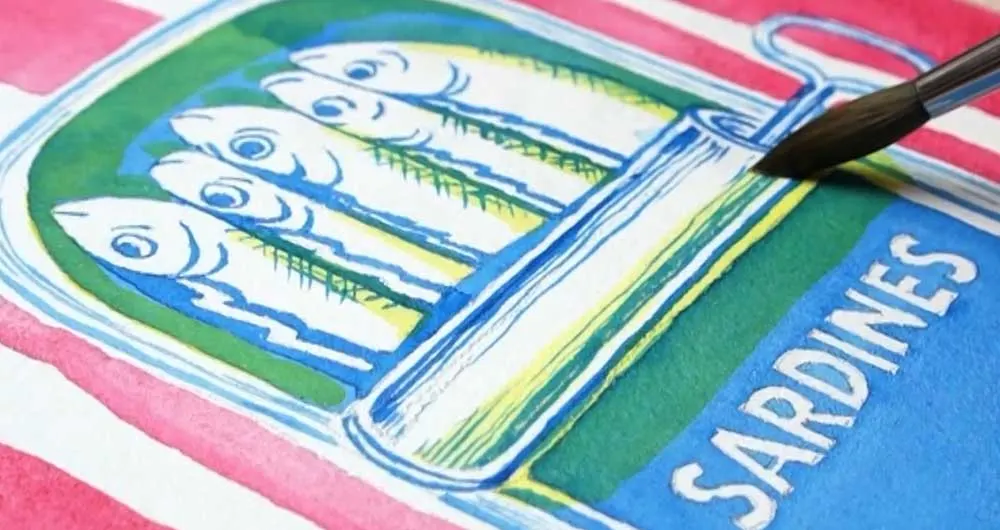
Understanding brush load and actually controlling it on paper are two different things, and only repetition closes the gap. Choose a small subject that has both broad shapes and very fine lines but no complicated color mixing, so all your attention stays on the brush. Fill the big areas with a loaded large brush, let it run down toward a point, then switch to the small round for the details, testing on scrap whenever you're unsure.
Before each stroke, look at the tip. Rounded and bulging means a generous, fast flow. Pointed means slow, controlled release. If it's not the mark you want, you now know what to change.


0 comments
Join the conversation