
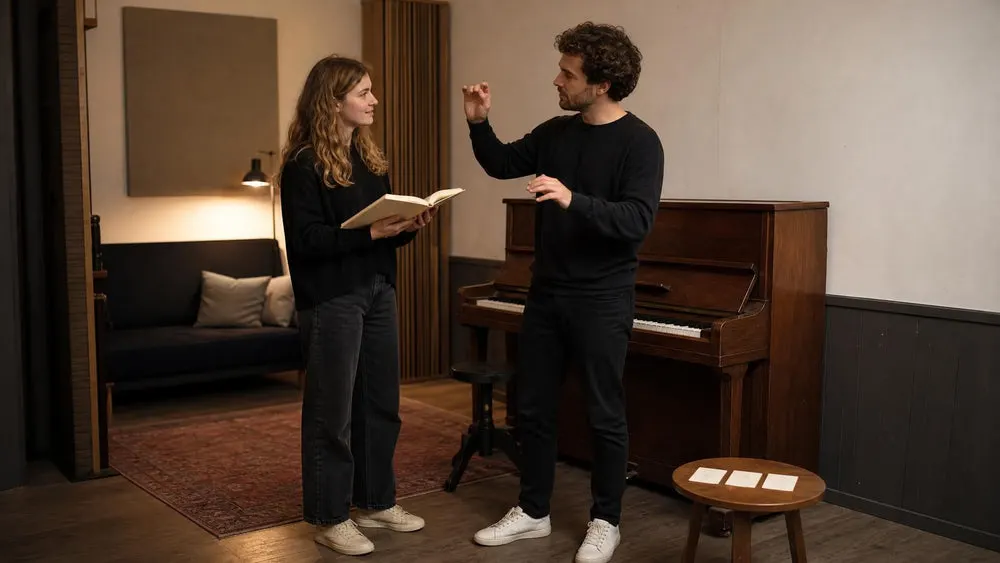
- Time
- 10 minutes, plus rehearsal follow-up
- Skill
- Beginner
- Group
- Bands, worship teams, ensembles, solo
- Output
- Up to three rehearsal actions
In 10 minutes after a show, you can lock in what worked, pin down the moments that went wrong, and leave with no more than three clear rehearsal actions. The format suits bands, worship teams and ensembles. Solo performers can ask themselves the same questions in a voice memo or practice notebook.
After a gig, details compete with packing cases, friends and the drive home. You remember that something felt awkward, but by the next rehearsal you may not remember which entrance, cue or transition caused it. A full critique while everyone is tired won't help. A short conversation that records specific moments, without judging anyone's ability or effort, will.
What you will need
- A shared note that everyone can find later
- One person to watch the clock and one to keep the note (the same person works in a small group)
- A pen and paper for each player
- A recording of the show, if you have one
- A metronome, for tempo questions
Set it up before the show
Agree on the debrief before you perform. If you wait until someone starts listing mistakes afterward, it will feel like a complaint session.
Find a spot where you can hear each other without shouting. If the stage has to be cleared right away, load out first. Before packing, each player jots down one thing that worked and one moment to revisit, naming the song and section. Then set a specific time to combine those notes, even if it's a short call the following day.
Observe first, explain later
Describe the moment before the cause. "I heard two different release points on the final chord" is something to investigate. "Nobody watched the leader" starts an argument before you know what happened. Listening reports count too: "I could not hear the count-in" doesn't prove the count-in was missing, but it flags something worth checking.
Step by step
-
Name what worked (minutes 0-2). Ask: "What did we do tonight that we should keep doing?" Look for answers that link an action to a result, such as "The shorter spoken introduction let us start the ballad without an awkward pause." Record one or two things to keep, so a working solution doesn't get replaced while you fix something else. In a larger group, take brief contributions and collect the rest in the shared note instead of going round the whole circle.
-
Locate the problem moments (minutes 2-6). Each person gives their highest-priority issue: song, section, what they noticed. Don't replay the whole set. "The transitions were bad" is too broad. "After song three, the count-in started while the keyboard patch was still changing" gives you a boundary to rehearse.
-
Note the musical consequence. Did a missed cue add an extra bar? Did a rushed entrance leave the singer behind? Did a setup handoff delay the next song? These details show whether a moment was an isolated slip or needs a shared plan.
-
Park what can wait. If someone starts defending or diagnosing, say: "Let's note what happened first, then choose what to try." Lower-priority issues and conflicting memories go on a parking list. If there's a recording, assign someone to check the passage before rehearsal. If there isn't, mark the cause as uncertain and test a clearer cue. Don't settle the past by majority vote.
-
Choose up to three actions (minutes 6-10). Favor repeated problems, unclear responsibilities, and spots where one small change helps several players. One useful action beats three vague ones. Give each an owner, a task and a success check. The owner makes sure the task happens. Being the owner doesn't mean that person caused the problem.
-
Read the actions aloud. Confirm that each owner knows the next step and that everyone knows where the note lives.
A note to copy
- Show and date: venue or service, date, set version
- Keep: the specific action that worked, and where
- Moment to revisit: song, section, observation, musical consequence
- Unconfirmed explanation: possible cause, kept separate from the observation
- Recording check or parking list: question, who is checking, when they report back
- Actions 1 to 3 (only as many as needed): owner, task, success check
- Next rehearsal: date and opening task
Open the next rehearsal with the actions
Put the actions at the top of the rehearsal plan. Don't spend another 10 minutes retelling the show. Read the observation, confirm the change, and play the passage.
Here is a worked example. The note says: "On the final held chord of the closing song, some players released before others." One player remembers a missed visual cue and another remembers no agreed cutoff. Leave that disagreement alone. What needs fixing is that the release needs a cue everyone recognizes.
Maya leads it. Everyone holds the chord until her hand closes, with a visible lift beforehand to prepare the release. Check that every player can see her from their performance position. Then:
- Start eight bars before the ending, using the same arrangement, positions and equipment changes as the show.
- Play through the cutoff and hold until the cue. Don't guess from the length of the chord.
- Check whether everyone released together without a spoken reminder. If not, decide whether the cue was unclear, unseen or misunderstood.
- Repeat until you get three consecutive clean releases. If one misses, clarify the cue and restart the count.
Then play the whole song without stopping. A cutoff that works in isolation still has to survive a full performance's worth of attention, movement and page turns.
Tempo needs its own check
Agree on a rehearsal reference with a metronome, then practice the count-in and first eight bars. Separate a start that feels too fast from speeding up later in the song. A rehearsal click helps you test the fix, but it can't tell you what tempo you played at the show.
Once a change works, write it where players will see it: the chart, setlist, cue sheet or setup checklist. Mark the action complete, or give it one specific next test. Save the note before your next show so you start rehearsal with something more useful than "good gig."




0 comments
Join the conversation